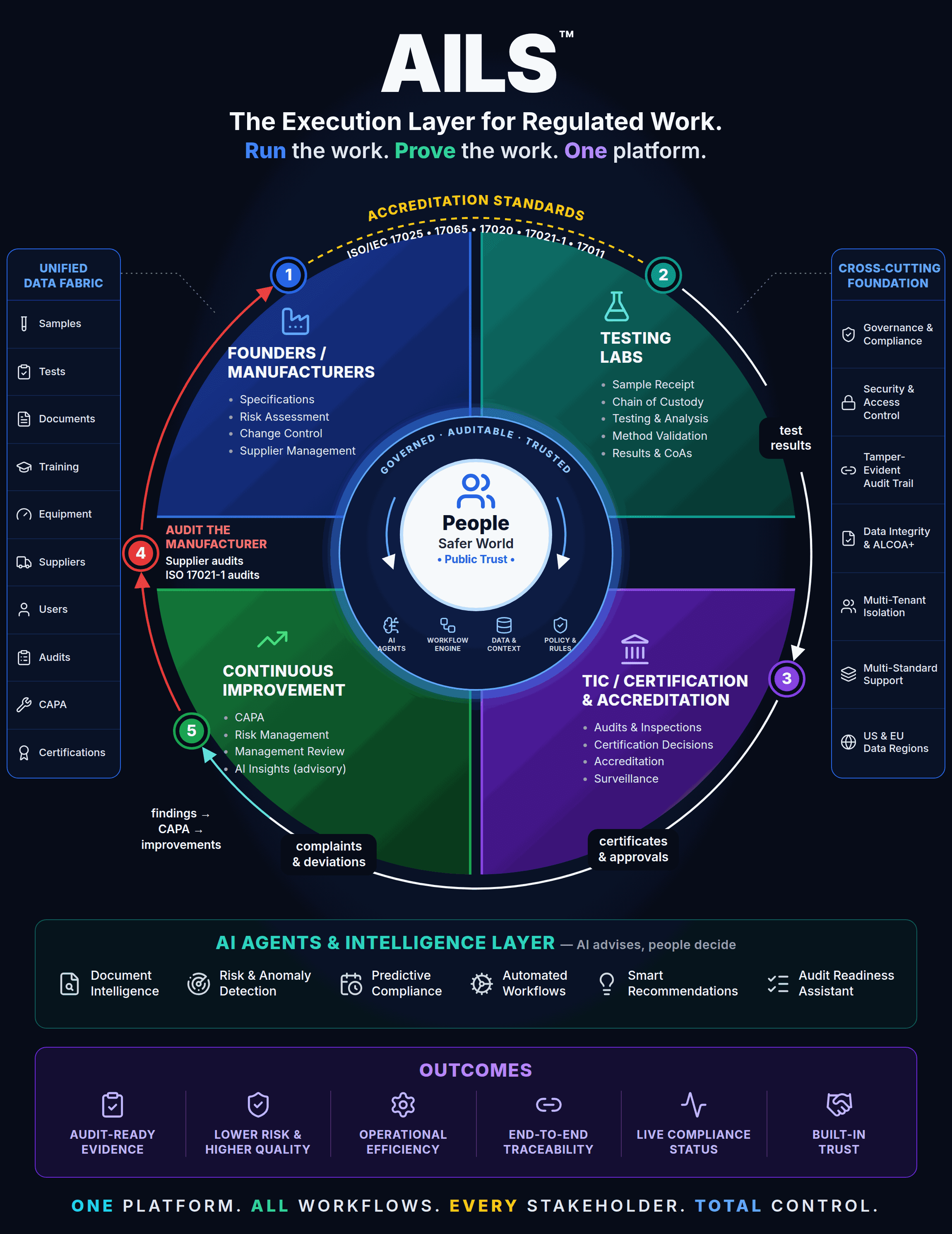
One platform. Four types of regulated organizations.
Built for every actor in the regulated supply chain.
Whether you are building a regulated product, running a commercial testing lab, operating a certification body, or managing a university research facility — AILS has a purpose-built compliance layer for your role. Every actor shares the same data operations layer, QMS, audit trail, and electronic signature infrastructure. Only the vertical modules differ.
Founders & Manufacturers
Building a regulated product — food, hardware, cosmetics, supplements — means compliance starts before your first commercial batch. AILS gives founders a production-ready QMS, COC/COA pipeline, and industry-specific compliance layer from day one, without hiring a quality team.
Food Safety
SQF Code 9.0 / HACCP / GFSI
The SQF vertical adds a complete HACCP and food safety compliance layer on top of your core testing and QMS platform. Every module is purpose-built to SQF Code 9.0 requirements — from HACCP plan development to CCP monitoring, PRPs, and supplier SQF qualification. The AI self-audit scores your facility against SQF clauses and writes a plain-English pre-audit action plan.
What's included
HACCP Plans
Develop HACCP plans with process steps, hazard analysis (biological, chemical, physical), and revision workflow. AI Reviewer evaluates against SQF Code 9.0 and all 7 HACCP principles — flags every gap.
Critical Control Points
Define CCPs with critical limits and monitoring procedures. When a log entry breaches limits, a deviation is automatically created and the AI Breach Analyzer identifies probable root cause and corrective action.
Prerequisite Programs
Manage all 8 SQF-required PRP categories — sanitation, pest control, allergen management, GMP, employee hygiene, waste, water/ice/steam, supplier control. AI Compliance Checker flags missing or weak programs.
SQF Self-Audit + AI Action Planner
Run a self-audit against SQF clauses. The AI scores your facility 0–100 and generates a plain-English action plan: the top 3 things to fix before your SQF audit, in order of urgency.
Supplier SQF Fields
Extend your supplier registry with SQF approval status, approval basis, allergen declaration, and food safety certificate number — all part of the SQF supplier qualification requirement.
SQF Management Meeting Injection
For SQF-enabled tenants, the monthly management review automatically appends 6 SQF-required agenda items to the ISO §8.9 meeting — one meeting covers both frameworks.
Cultivation
GACP Compliant · FDA Schedule III Ready
Complete seed-to-harvest documentation for cannabis, hemp, mushrooms, and botanicals — built to satisfy WHO GACP and pre-positioned for FDA Schedule III oversight before final rules are published. Includes a forward-looking FDA Schedule III readiness score.
What's included
Batch & Growth Stage Tracking
Full batch lifecycle from germination through curing — cultivar, zone, plant count, stage transitions, state tracking ID, and responsible tech. Audit-ready from first seed.
Environmental & Nutrient Logs
Daily environmental readings (temp, humidity, VPD, CO₂, pH, EC, light) and feeding records with pH/EC before-and-after — the continuous monitoring FDA cGAP will require.
IPM Program with Pre-Harvest Intervals
Pest and disease inspection logs with treatment records, OMRI-listed flag, pre-harvest interval, and re-entry interval — FDA Schedule III will mandate full PHI documentation.
Dual-Witness Waste Destruction
Harvest records with wet/dry/trim weights, yield variance detection (auto-flags >20% deviation), and dual-witness waste sign-off — the FDA-required gold standard for cannabis waste.
Approved Input Registry
Facility-wide approved inputs list with OMRI status, EPA and state registration numbers, PHI/REI, and approval audit trail — the backbone of a defensible pesticide compliance program.
GACP + FDA Readiness Self-Audit
AI evaluates your facility against WHO GACP principles and anticipated FDA Schedule III cGAP requirements — scores 0–100 and generates an action plan. Download a full PDF audit report.
Construction Materials
ASTM Standards · ISO 17025 · ACI 318 · AASHTO
Concrete, asphalt, aggregate, steel, and geotechnical testing with automated ASTM specification compliance review and accept/reject recommendations. Every sample is tracked from field collection through reporting, with an AI Construction QC Reviewer that evaluates results against ASTM limits and returns structured findings with severity classifications.
What's included
Multi-Material Sample Tracking
Log concrete, asphalt, aggregate, steel, and geotechnical samples with project name, location, collection date, and field technician. Full status tracking from received through reported.
ASTM Result Management
Record test results with ASTM method codes, spec min/max limits, and units. withinSpec is auto-computed at entry — no manual comparison required.
AI Construction QC Reviewer
The AI evaluates all results for a sample against ASTM specification limits appropriate for the material type and returns a structured accept/conditional-accept/reject recommendation with per-analyte findings and severity.
Test Methods Expert Agent
AI-powered method suggestion engine generates 3 scaffold methods per category (Concrete, Asphalt, Steel, Geotechnical) tailored to the sample type and project — suggestions only, user confirms before import.
Scaffold Method Registry
12 standard ASTM methods pre-loaded (3 per category): ASTM C39, C138, C143, D6926, D2726, D5444, A370, D422, D4318, D2216 — seeded into your TestMethod registry in one click.
Full Audit Trail & COC Integration
Every sample creation, status change, result entry, and QC review is audit-logged. Link samples directly to chain-of-custody records for end-to-end project traceability.
Agricultural & Environmental
EPA Methods / ISO 17025 / OMRI / State Pesticide Regulations
Soil chemistry, water quality, air quality, and pesticide residue testing with automated compliance checking against EPA MCLs, OMRI standards, and state action levels. Every sample is tracked from collection through reporting, with an AI Compliance Checker that evaluates results against the appropriate regulatory framework and returns structured findings and recommendations.
What's included
Multi-Matrix Sample Tracking
Log soil, water, air, and plant-tissue samples with collection location, date, collector, COC linkage, and status tracking from received through reported.
Test Result Management
Record analyte results with method codes, units, detection limits, and action levels. Action level exceedances are automatically flagged at entry — no manual comparison required.
AI Compliance Checker
The AI evaluates all results for a sample against the appropriate regulatory framework — EPA MCLs for water, OMRI standards for soil, state pesticide action levels for plant tissue — and returns structured findings with severity and remediation guidance.
Test Methods Expert Agent
AI-powered method suggestion engine generates 5 scaffold methods per category (Soil Chemistry, Water Quality, Air Quality, Pesticide Residue) tailored to the sample type and location — suggestions only, user confirms before import.
Scaffold Method Registry
20 standard EPA methods pre-loaded: SM 4500-H+, EPA 351.2, EPA 365.4, EPA 8270D, EPA TO-15, EPA IO-2.1, and more — seeded into your TestMethod registry in one click.
Full Audit Trail & COC Integration
Every sample creation, status change, result entry, and compliance check is audit-logged. Link samples directly to chain-of-custody records for end-to-end traceability.
Testing Labs
Commercial labs are the operational core of the regulated supply chain. AILS is built around the COC-to-COA workflow, with a full QMS, equipment management, proficiency testing, and AI-powered compliance checking layered on top. Every vertical adds the framework-specific modules your accreditation body requires.
Food Safety
SQF Code 9.0 / HACCP / GFSI
The SQF vertical adds a complete HACCP and food safety compliance layer on top of your core testing and QMS platform. Every module is purpose-built to SQF Code 9.0 requirements — from HACCP plan development to CCP monitoring, PRPs, and supplier SQF qualification. The AI self-audit scores your facility against SQF clauses and writes a plain-English pre-audit action plan.
What's included
HACCP Plans
Develop HACCP plans with process steps, hazard analysis (biological, chemical, physical), and revision workflow. AI Reviewer evaluates against SQF Code 9.0 and all 7 HACCP principles — flags every gap.
Critical Control Points
Define CCPs with critical limits and monitoring procedures. When a log entry breaches limits, a deviation is automatically created and the AI Breach Analyzer identifies probable root cause and corrective action.
Prerequisite Programs
Manage all 8 SQF-required PRP categories — sanitation, pest control, allergen management, GMP, employee hygiene, waste, water/ice/steam, supplier control. AI Compliance Checker flags missing or weak programs.
SQF Self-Audit + AI Action Planner
Run a self-audit against SQF clauses. The AI scores your facility 0–100 and generates a plain-English action plan: the top 3 things to fix before your SQF audit, in order of urgency.
Supplier SQF Fields
Extend your supplier registry with SQF approval status, approval basis, allergen declaration, and food safety certificate number — all part of the SQF supplier qualification requirement.
SQF Management Meeting Injection
For SQF-enabled tenants, the monthly management review automatically appends 6 SQF-required agenda items to the ISO §8.9 meeting — one meeting covers both frameworks.
Pharma / GMP
FDA 21 CFR Part 211 / ICH Guidelines
The Pharma vertical adds full pharmaceutical-grade workflows on top of the core testing and QMS platform. OOS investigations, ICH-compliant stability studies, method validation, batch release with AI risk scoring, change control, and mandatory second-person COA review. Every workflow enforces re-authentication and electronic signatures per 21 CFR Part 11.
What's included
OOS Investigations
Two-phase OOS workflow — Phase 1 lab investigation then Phase 2 full investigation. The AI pre-populates the Phase 1 root cause checklist when the investigation advances, based on the test method, analyte, and recent deviation history.
Method Validation
ICH-compliant method validation with all required parameters: accuracy, precision, linearity, LOD/LOQ, specificity, robustness. Three-level sign-off: analyst → reviewer → QA approver.
Stability Studies
ICH Q1A/Q1B/Q1E/Q5C protocols with per-timepoint result entry. The AI Trend Interpreter narrates each parameter in plain English and flags projected specification breaches before they happen.
Batch Release
QC review followed by QA release decision. AI Risk Scorer evaluates all linked data — specifications, open OOS, deviations, stability trend risk, reserve sample status — and returns a release/hold/conditional recommendation before QA acts.
Change Control & Reserve Samples
Change control with impact assessment and approval workflow. Reserve sample registry with retention tracking, auto-computed expiry dates, and a formal disposal workflow.
COA Second-Person Review
Mandatory second reviewer sign-off on every COA before issuance. Same-user block prevents the analyst from being their own reviewer. Full re-authentication required.
CLIA
Clinical Laboratory Improvement Amendments — 42 CFR Part 493
The CLIA vertical delivers complete clinical laboratory compliance workflows aligned to 42 CFR Part 493. Patient test result management with critical value notification, Westgard-rule QC logging with auto-deviation creation, CAP/COLA proficiency testing with AI-assisted failure investigation, CLIA personnel qualification tracking, calibration verification scheduling, an AI self-audit against Part 493, and an HL7 FHIR R4 EMR Integration Agent that connects to FHIR-compatible EMRs (Epic, Cerner, Meditech, Allscripts) — supporting inbound order and outbound result sync over FHIR.
What's included
Patient Test Result Management
Log, review, and report patient results with reference range comparison, L/H/critical flagging, and critical value notification documentation — all on a full electronic audit trail.
CLIA QC Records & Westgard Rules
Per-run QC log with Westgard 1-3s / 1-2s violation detection, z-score computation, and auto-deviation creation on QC failure. AI Trend Analyzer identifies root cause patterns across 30-day QC history.
Proficiency Testing (CAP/COLA/AABB)
Track PT enrollments, per-analyte results, pass/fail grading, and mandatory investigation requirements. AI PT Failure Investigator pre-populates root cause investigation for failed events per §493.801.
Personnel Qualifications (§493 Subpart M)
Record and track Lab Director, Technical Supervisor, Clinical Consultant, General Supervisor, and Testing Personnel qualifications, credentials, competency assessments, and license expiries. AI Compliance Checker surfaces Subpart M coverage gaps.
Calibration Verification
Document calibration verification across the reportable range with % recovery computation and auto-scheduled due dates (every 6 months for moderate/high complexity, annually for waived).
CLIA Self-Audit (42 CFR Part 493)
AI audit maps live system data to 8 Part 493 subpart areas — scores 0–100 and generates a plain-English action plan for the top issues to resolve before a CLIA inspection.
EMR Integration Agent — HL7 FHIR R4
Connects to FHIR-compatible EMRs (Epic, Cerner, Meditech, Allscripts) via HL7 FHIR R4. Inbound ServiceRequest orders auto-populate AILS sample records; outbound DiagnosticReport results push back to the EMR. An AI agent handles field mapping, troubleshooting, and sync-log review over the standard FHIR API.
HIPAA Business Associate Agreement available — included in CLIA setup
Agricultural & Environmental
EPA Methods / ISO 17025 / OMRI / State Pesticide Regulations
Soil chemistry, water quality, air quality, and pesticide residue testing with automated compliance checking against EPA MCLs, OMRI standards, and state action levels. Every sample is tracked from collection through reporting, with an AI Compliance Checker that evaluates results against the appropriate regulatory framework and returns structured findings and recommendations.
What's included
Multi-Matrix Sample Tracking
Log soil, water, air, and plant-tissue samples with collection location, date, collector, COC linkage, and status tracking from received through reported.
Test Result Management
Record analyte results with method codes, units, detection limits, and action levels. Action level exceedances are automatically flagged at entry — no manual comparison required.
AI Compliance Checker
The AI evaluates all results for a sample against the appropriate regulatory framework — EPA MCLs for water, OMRI standards for soil, state pesticide action levels for plant tissue — and returns structured findings with severity and remediation guidance.
Test Methods Expert Agent
AI-powered method suggestion engine generates 5 scaffold methods per category (Soil Chemistry, Water Quality, Air Quality, Pesticide Residue) tailored to the sample type and location — suggestions only, user confirms before import.
Scaffold Method Registry
20 standard EPA methods pre-loaded: SM 4500-H+, EPA 351.2, EPA 365.4, EPA 8270D, EPA TO-15, EPA IO-2.1, and more — seeded into your TestMethod registry in one click.
Full Audit Trail & COC Integration
Every sample creation, status change, result entry, and compliance check is audit-logged. Link samples directly to chain-of-custody records for end-to-end traceability.
Construction Materials
ASTM Standards · ISO 17025 · ACI 318 · AASHTO
Concrete, asphalt, aggregate, steel, and geotechnical testing with automated ASTM specification compliance review and accept/reject recommendations. Every sample is tracked from field collection through reporting, with an AI Construction QC Reviewer that evaluates results against ASTM limits and returns structured findings with severity classifications.
What's included
Multi-Material Sample Tracking
Log concrete, asphalt, aggregate, steel, and geotechnical samples with project name, location, collection date, and field technician. Full status tracking from received through reported.
ASTM Result Management
Record test results with ASTM method codes, spec min/max limits, and units. withinSpec is auto-computed at entry — no manual comparison required.
AI Construction QC Reviewer
The AI evaluates all results for a sample against ASTM specification limits appropriate for the material type and returns a structured accept/conditional-accept/reject recommendation with per-analyte findings and severity.
Test Methods Expert Agent
AI-powered method suggestion engine generates 3 scaffold methods per category (Concrete, Asphalt, Steel, Geotechnical) tailored to the sample type and project — suggestions only, user confirms before import.
Scaffold Method Registry
12 standard ASTM methods pre-loaded (3 per category): ASTM C39, C138, C143, D6926, D2726, D5444, A370, D422, D4318, D2216 — seeded into your TestMethod registry in one click.
Full Audit Trail & COC Integration
Every sample creation, status change, result entry, and QC review is audit-logged. Link samples directly to chain-of-custody records for end-to-end project traceability.
IEC Electrical Testing
IECEE CB Scheme · IECEx System · IEC 60079 / 62271 series
Full IEC electrical test lab workflow — from method library and test report authoring through to CB certificate issuance, IECEx QAR documentation, and an AI narrative generator grounded in your Standards Knowledge Base. When a test report is ready, the AI drafts scope, conditions, results narrative, and conclusions using the actual IEC clause text — not generic language.
What's included
IEC Method Library
13 standard IEC test methods pre-seeded across IEC 60079-0/1/11, IEC 62271-100/200, and related standards — ready as templates for new test reports in one click.
Test Report Authoring + AI Narrative Generator
Create formal test reports with DUT details, test conditions, and per-clause test items. The AI Narrative Generator drafts scope, test conditions, a 3–5 paragraph results narrative, and formal conclusions — grounded in IEC standard clauses retrieved from your Standards KB.
Standards Knowledge Base
Upload IEC standard PDFs and your platform builds a semantic search index over the clause text. Relevant clauses are retrieved at generation time so narratives cite exact clause references, not approximations.
CB Certificates (IECEE CB Scheme)
Issue CB Scheme certificates with auto-generated tamper-evident certificate numbers, re-authentication on issuance, SHA-256 integrity hash, and full PDF generation. Withdraw certificates with documented reason and full audit trail.
IECEx Quality Assessment Reports
Document IECEx System QARs for explosive atmospheres equipment — Ex marking, equipment protection level, gas group, temperature class, and IEC 60079 clause-by-clause compliance records. Issued on the same workflow as CB certificates.
Full Traceability — Application to Certificate
Certification applications, test reports, and issued certificates share the same platform. Full traceability from intake through test report to CB certificate or IECEx QAR — no copy-paste between systems.
TIC / Certification Bodies
Testing, inspection, and certification bodies operate under ISO 17065 and ILAC/IAF requirements that most LIMS platforms ignore entirely. AILS has the full certification lifecycle built in: application intake, impartiality screening, tamper-evident certificate issuance with public verification, surveillance scheduling, and complaint management.
Certification Body
ISO 17065 / IAF MLA / ILAC MRA
Full certification lifecycle management — application intake, evaluation workflow, impartiality risk screening, certificate issuance, public verification directory, and surveillance scheduling.
What's included
Application Intake & Evaluation Workflow
Receive and process product certification applications through a structured evaluation workflow. Status machine: Received → Under Evaluation → Additional Info Required → Approved / Rejected / Withdrawn.
Impartiality Risk Screener (ISO 17065 §4.2)
AI agent screens every application for evaluator conflict of interest — same evaluator previously worked with the applicant, evaluator named in an existing certificate for the company, or competitive product certification bias. Auto-flags and notifies admins.
Certificate Issuance & Public Directory
Issue product certificates with auto-generated tamper-evident certificate numbers (CERT-[YEAR]-[SEQ]). Mark certificates for public verification directory. Track status: Active, Suspended, Withdrawn, or Expired.
Tamper-Evident PDF Certificate Generation
On issuance, the platform automatically generates a tamper-evident Certificate of Conformity PDF — including cert number, issue/expiry dates, product details, standards certified to, issuing body name, signature lines, and a public verification QR code. PDF is generated at issuance and tied to the certificate record.
Public Certificate Verification Directory
Any externally issued certificate marked "publicly listed" is immediately searchable at ailabservices.com/verify — no login required. Customers and regulators can verify cert number, status (Active/Suspended/Withdrawn/Expired), product details, standards, issue and expiry dates, and issuing body in seconds.
Certificate Expiry & Surveillance Intelligence
One-click AI digest that scans all active certificates and surveillance schedules, then generates a plain-English Markdown report: certs expiring within 90 days (sorted by urgency), overdue surveillance visits, and upcoming surveillance due within 30 days — each with recommended action.
ISO 17065 Complaint Management
Log, categorise, and track certification complaints (Technical, Process, Impartiality, Other) through a full status lifecycle: Received → Under Review → Resolved → Closed. Resolution notes, resolver name, and timestamp recorded on closure. Full audit trail per ISO 17065 §7.10.
Surveillance Scheduling
Schedule and record post-issuance surveillance visits with outcome recording (Satisfactory / Conditional / Unsatisfactory), findings, and automatic CAPA linkage for non-conformances. Overdue items flagged in red, due-soon in amber.
Linked Testing Records
Link each certification application to COC and COA records in the same platform — full traceability from test report to issued certificate, no copy-paste between systems.
Full Audit Trail
Every status change, evaluation note, impartiality check, certificate issuance, suspension, and surveillance outcome is recorded on the tamper-evident, hash-chained platform audit trail — ready for IAF/ILAC peer review.
ISO/IEC 17011 Accreditation Body
ISO/IEC 17011:2017 / IAF MLA / ILAC MRA
Full accreditation body operations: application intake, assessments, accreditation certificates, surveillance calendar, assessor register, complaints and appeals. The AI conflict-of-interest screener (ISO 17011 cl. 5.2) evaluates every assessor assignment for prior relationships with the applicant body. Decision independence is enforced at the API layer — if the certificate decision-maker was on the assessment team, issuance is rejected with the clause cited. Completes the closed-loop trust chain: Manufacturer → Testing Lab → Certification Body → Accreditation Body — one governed platform.
What's included
Application Intake & Assessment Workflow
Receive and process accreditation applications through a structured assessment workflow. Status machine from received through desk review, on-site assessment, decision, and issuance.
AI Conflict-of-Interest Screener (ISO 17011 cl. 5.2)
AI agent screens every assessor assignment for impartiality risk — prior employment at the applicant body, financial relationship, or previous adverse finding — and auto-flags assignments that violate impartiality requirements.
Decision Independence Enforcement
API-layer rule: if the accreditation decision-maker appears on the assessment team for the same application, certificate issuance is rejected with the specific ISO 17011 clause cited. Structural enforcement, not policy.
Accreditation Certificate Issuance
Issue accreditation certificates with auto-generated tamper-evident certificate numbers, re-authentication on issuance, SHA-256 integrity hash, and full PDF generation. Full traceability from application through certificate.
Surveillance Calendar & Assessor Register
Schedule and record post-accreditation surveillance visits. Maintain an assessor register with qualifications, assignments, impartiality declarations, and availability — all audit-ready for IAF peer review.
Portfolio Intelligence Digest
One-click AI digest that scans all active accreditation certificates, upcoming surveillance, and open applications — and generates a plain-English summary with prioritized action items for the accreditation committee.
IEC Electrical Testing
IECEE CB Scheme · IECEx System · IEC 60079 / 62271 series
Full IEC electrical test lab workflow — from method library and test report authoring through to CB certificate issuance, IECEx QAR documentation, and an AI narrative generator grounded in your Standards Knowledge Base. When a test report is ready, the AI drafts scope, conditions, results narrative, and conclusions using the actual IEC clause text — not generic language.
What's included
IEC Method Library
13 standard IEC test methods pre-seeded across IEC 60079-0/1/11, IEC 62271-100/200, and related standards — ready as templates for new test reports in one click.
Test Report Authoring + AI Narrative Generator
Create formal test reports with DUT details, test conditions, and per-clause test items. The AI Narrative Generator drafts scope, test conditions, a 3–5 paragraph results narrative, and formal conclusions — grounded in IEC standard clauses retrieved from your Standards KB.
Standards Knowledge Base
Upload IEC standard PDFs and your platform builds a semantic search index over the clause text. Relevant clauses are retrieved at generation time so narratives cite exact clause references, not approximations.
CB Certificates (IECEE CB Scheme)
Issue CB Scheme certificates with auto-generated tamper-evident certificate numbers, re-authentication on issuance, SHA-256 integrity hash, and full PDF generation. Withdraw certificates with documented reason and full audit trail.
IECEx Quality Assessment Reports
Document IECEx System QARs for explosive atmospheres equipment — Ex marking, equipment protection level, gas group, temperature class, and IEC 60079 clause-by-clause compliance records. Issued on the same workflow as CB certificates.
Full Traceability — Application to Certificate
Certification applications, test reports, and issued certificates share the same platform. Full traceability from intake through test report to CB certificate or IECEx QAR — no copy-paste between systems.
Medical Device TIC
ISO 17025 Test Lab · ISO 17065 Cert Body · HL7 FHIR R4 EMR
Medical device testing, inspection, and certification (TIC) requires three capabilities that most platforms treat as separate products: an ISO 17025-compliant test lab, an ISO 17065 certification body, and a live connection to the hospital EMR. AILS has all three. The same platform manages test reports and measurement uncertainty, issues device certificates, and connects to FHIR-compatible EMRs (Epic, Cerner, Meditech) via HL7 FHIR R4.
Planned modules
ISO 17025 Test Lab
Method validation (ICH Q2(R1) parameters), GUM-compliant measurement uncertainty budgets, OOS investigations, stability studies, and an AI-powered ISO 17025 self-audit. Full traceability from sample receipt through test report issuance.
ISO 17065 Certification Body
Application intake, impartiality risk screening (ISO 17065 §4.2), certificate issuance with tamper-evident PDF generation, public verification directory, surveillance scheduling, and complaint management — everything an accredited product certification body needs.
HL7 FHIR R4 EMR Integration
Connects to FHIR-compatible EMRs (Epic, Cerner, Meditech) over HL7 FHIR R4. Inbound ServiceRequest orders auto-populate AILS sample records; outbound DiagnosticReport results push device test data back to the hospital system. An AI field-mapping agent handles schema differences over the standard FHIR API.
Measurement Uncertainty
Per-method uncertainty budgets with GUM-compliant combined uncertainty calculation and k-factor expansion. Uncertainty values are available for inclusion in test reports and COAs for ISO 17025 accreditation submissions.
Full QMS Layer
CAPA, deviations, internal audits, supplier qualification, training records, and risk register — a complete quality management layer built in to every tenant, not a separate add-on.
21 CFR Part 11 & Electronic Signatures
Re-authentication on every certificate issuance and COA signing, full electronic signature metadata, tamper-evident, hash-chained audit trail, and SHA-256 document integrity hashes — 21 CFR Part 11 e-signature controls included at every tier.
Institutional
Universities, colleges, government research labs, and non-profits have compliance and data-sharing needs that commercial LIMS platforms treat as afterthoughts. AILS adds grant cost allocation with F&A overhead, FAIR data publishing with DOI-ready metadata, funder mandate tracking, and an academic terminology mode — all on the same platform as your core lab operations.
Institutional & University Labs
Grant Tracking / FAIR Data / Multi-Department
University core facilities, government research labs, and multi-department research centres have needs that commercial LIMS platforms ignore: grant cost allocation with F&A overhead, FAIR data mandates from NIH and Horizon Europe, and terminology that fits academic workflows (submissions instead of chain-of-custody, lab reports instead of certificates). AILS adds all of this without replacing your core LIMS.
What's included
Grant Tracking & F&A Overhead
Create grant records with budget, indirect rate, PI, agency, and award number. Allocate direct costs from specific COCs and COAs to grants — F&A (facilities & administrative) overhead is calculated automatically using your negotiated indirect rate. Live burn-rate dashboard with color-coded alerts at 60% and 85% spend.
F&A Calculator
Per-grant indirect cost calculator with NIH 15% MTDC cap toggle. Enter direct costs and instantly see F&A, modified total direct cost (MTDC) cap enforcement, and total chargeable cost — before committing the allocation.
FAIR Data Publishing
Mint a persistent FAIR identifier for every issued lab report. Set sharing status (private / restricted / public) and publish reports with a stable share URL — no login required for collaborators. Metadata exports include schema.org JSON-LD (for data repositories) and DataCite-compatible JSON (for DOI deposit workflows).
Funder Mandate Support
Link reports to NIH Data Management and Sharing Policy, Horizon Europe Open Data mandates, or NSERC DORA requirements. Attach PI ORCID iDs and institution ROR identifiers — the metadata is machine-readable and ready for submission to Zenodo, Dryad, or Figshare.
Academic Terminology Mode
"Lab Mode" toggle switches the entire platform interface from commercial to academic terminology: Chain of Custody becomes Sample Submission, Certificate of Analysis becomes Lab Report, Client becomes Principal Investigator, Invoice becomes Internal Chargeback. Configurable per tenant.
Multi-Department Structure
Organize users into departments with cost centres. Institution admins can view consolidated billing across all departments, track grant allocation by department, and manage access without touching individual tenant settings.
Plans start at $299 a month with 5 users included. Academic discounts available — contact us. Includes grants + FAIR data modules.
47 more regulated industry applications
Every vertical below runs on the same platform infrastructure already deployed. The COC/COA pipeline, QMS, audit trail, and e-signature layer are already there — each vertical is a compliance module on top.
Note: “Live” indicates the underlying platform modules are deployed and activatable for qualifying tenants. It does not indicate AILS has been independently validated, accredited, or certified for any specific regulatory programme. Customers are responsible for their own validation, accreditation, and regulatory compliance.
4 applications — contact us to discuss
These verticals require highly specialised compliance expertise or regulatory depth that is not yet available on the platform. Contact us to register interest or discuss a custom engagement.
A platform that keeps expanding into regulated verticals
with zero architectural changes.
10 live vertical modules. Zero architectural changes to the core platform. Every vertical is a module layer — not a new product.