Built inside a working lab.
Not designed around one.
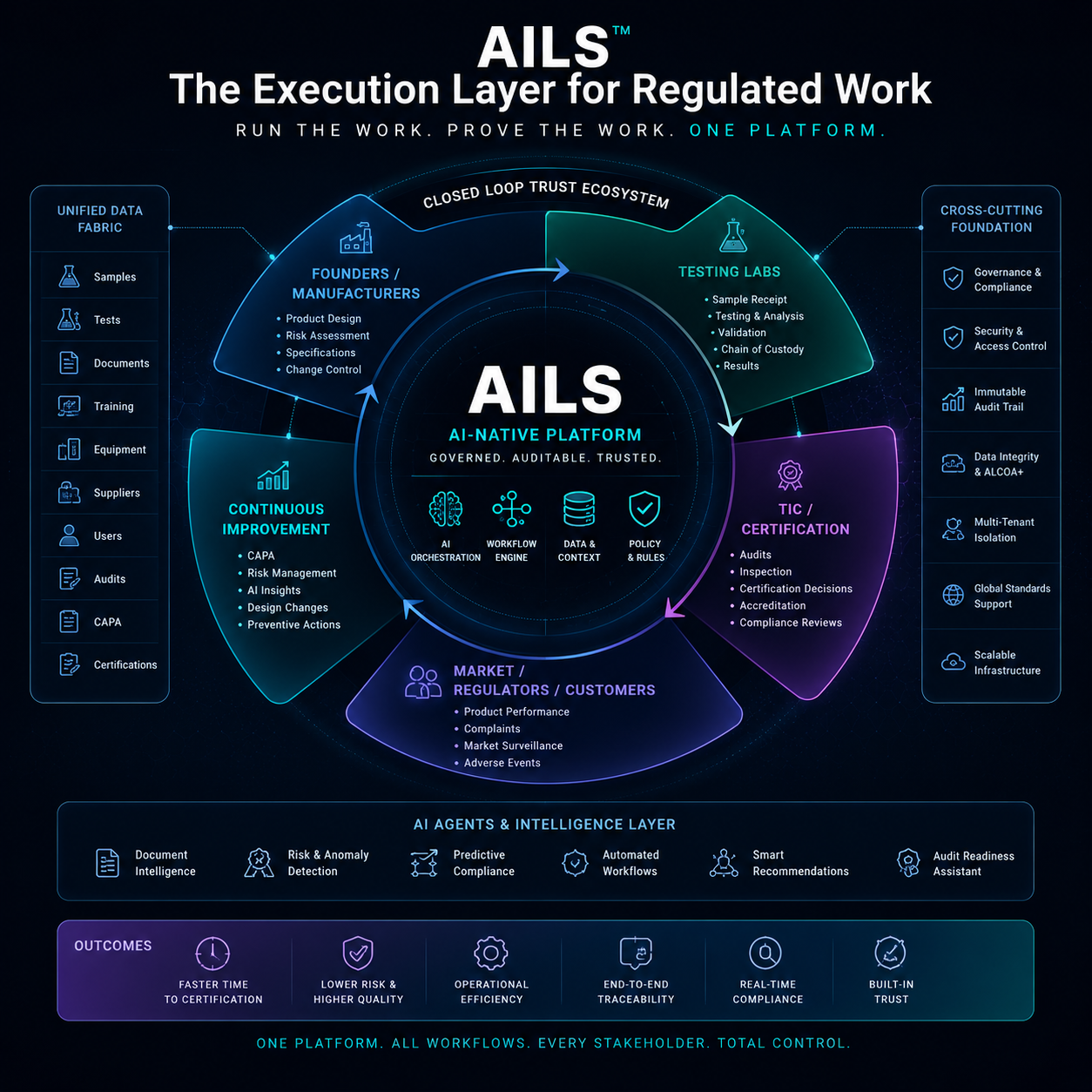
Every architectural decision in AILS reflects a constraint the team lived with first — as operators of dual-licensed accredited microbial testing facilities, not as software engineers guessing at lab workflows.
How a lab operator built the platform his lab actually needed.
BRS Lab Services operates accredited microbial testing facilities in Windsor, ON and Canton, MI — running under ISO 17025, CLIA, and dual US–Canada regulatory requirements. The lab needed software that matched that complexity. Nothing on the market did.
AI Lab Services was built entirely through AI-assisted development — conversation by conversation, module by module — without a dev team or prior coding background. The first COC was processed in the platform in late 2024. By 2025, all lab operations had migrated off spreadsheets.
Founded by a Marine Corps veteran who rebuilt from significant setbacks. The platform reflects that discipline: build the constraint first, then execute against it. CoAs locked after issue. Re-authentication at signing. Tenant-scoped isolation. None of these were customer requests. They were operational requirements designed in before the first user ever logged in.
Why being built inside a lab changes the architecture.
Three constraints we designed in before the first user logged in — because we knew auditors would eventually test each one.
CoAs locked against edits at issue
Issued COAs are write-locked. Not a policy — an architectural constraint. No edit, no re-issue — not even by platform admins. SHA-256 hash. Verifiable by your auditor.
Re-authentication at the moment of signing
Every critical signature requires password re-entry at the moment of signing. A logged-in session is not sufficient. We designed this before any customer asked — because we knew auditors would eventually test it.
Tenant-scoped data isolation
We operate labs in two regulatory jurisdictions. Cross-tenant data leakage is not a risk we could accept. Every query is scoped to the tenant, checked by an isolation test suite on every release. Tenants that need their data held separately get a dedicated database through bring-your-own database or EU hosting.
“We built AI Lab Services because we ran out of patience with legacy LIMS that cost $50,000 to implement and still required spreadsheets to manage day-to-day operations. Labs shouldn't have to choose between compliance and usability.”
Matt DeWolfe
Founder, AI Lab Services & BRS Lab Services
Want to see what this looks like in practice? Read the BRS Lab Services case study — the accredited lab that AILS was built inside.
Read the case study →